


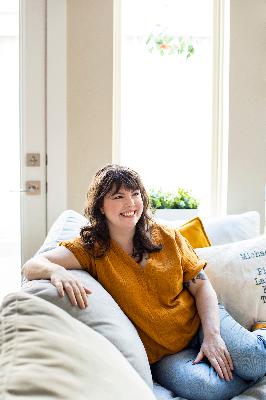
"I Love a Beautiful Home, But it Doesn't Rank Higher than Being Able to Function in My Space."
Description
We’ve done the same thing with housekeeping that we did with physical health: You are morally obligated to have this very clean, very organized, very aesthetically pleasing home, particularly if you are socialized as a woman. And if you do not do that, you deserve my shame and derision and criticism and all that stuff. So that’s when I started talking about this idea that care tasks are morally neutral.
You’re listening to Burnt Toast. This is the podcast where we talk about diet culture, fatphobia, parenting and health. I’m Virginia Sole-Smith I also write the Burnt Toast newsletter.
Today I am super excited to be chatting with KC Davis! KC is a licensed professional therapist, author, speaker and the person behind the mental health platform Struggle Care. She is domestic blisters on TikTok. And she is the author of How to Keep House While Drowning, a book that I read earlier this year and just cannot say enough good things about.
I started thinking about this conversation after I wrote an essay on organization as a hobby. KC is very, very good at helping us break down all of the assumptions we make about what our houses need to look like, about what care tasks need to look like, and at offering ways to reframe all of that so that your space actually serves you instead of measuring up to some unsustainable ideal, which you know, we are all about doing here. So here’s KC!
Episode 73 Transcript
KC
I started my TikTok channel, gosh, I guess we’re coming up on three years ago. I primarily use it to talk about how we can take care of ourselves when we’re in a hard spot. So for some people that’s a hard season of life. For other people that is a lifelong disability or maybe a bout with mental illness. Maybe it’s just being overwhelmed or being burnt out or any number of barriers that can make it difficult to care for ourselves.
I think that when we think about caring for ourselves, there are two main things out there mainstream and one is the “self care” movement, which in my experience can get very privileged. You know, a lot of bubble baths and pedicures and talking about things that require the privilege of extra time and money. And then when we talk about care tasks, like doing the laundry, and the dishes and things like that, if you want help with that, I often find that a lot of the resources out there are what I call like “boot camp” style motivation, where it’s like “Get up! Figure it out! Have some self respect!” like, “Do it!” And I don’t find those very motivating.
So my content is the cross-section between mental health and and care tasks, and how we can use self compassion and accessibility and accommodations to raise the quality of our life and make it a little bit easier to take care of ourselves.
Virginia
I first got obsessed with your work when my friend
of
In Pursuit of Clean Countertops
sent mea postyou did about super pretty laundry rooms, and it says “this is a hobby.” It was such an epiphany for me, I have to tell you. I don’t know, I’d always sort of thought that pretty laundry room kind of content was supposed to be about organization. That it was supposed to be about making your life easier. AndI had this sense of “Well, it’s intended to be helpful and if it’s making me feel bad, it’s just because I’m not doing doing it right.” And as I was making notes for our conversation and I wrote that down, I was like, “Oh, that’s diet culture.That’s perfectionism.”
I would love for you to talk a little bit about how you came to realize that so much of what we’re told we should do or have to do in terms of domestic work is unrealistic and unsustainable and unhelpful?
KC
When people ask how I fell into talking about this philosophy, I can point to several things in my life that led to that moment. I could talk about my history with addiction, I can talk about my history as a therapist, I can talk about my history in high control groups. But one of the main things was probably two or three years prior to starting my TikTok channel, I got into the anti-diet movement and opened my eyes to this idea that we might say, “Oh, it’s about health, it’s about health, it’s about health,” but we’ve also moralized “being healthy” to mean if you’re not striving to be the best human specimen that ever existed, that’s a moral failing on your part. And because that’s a moral failing, you deserve derision and shame.
So I learned that from listening to anti-diet creators, from listening to fat liberation advocates, and it really sunk in and changed my relationship to food and my relationship to my body. And then fast forward two years, I found myself postpartum with a toddler, in a new city where I didn’t know anybody. My husband had just started a new job as a lawyer and the pandemic shutdown happened. We both were—all of us in the house—were just drowning in trying to keep up with the dishes and the laundry, and the cleaning, and the tidying and the bottles and the this and the that. And as I began to talk in my videos about like, “hey, here’s a way that I’m making cleaning a little bit easier,” so many people started to speak up and say this similar sentiment of “I love seeing your house because it looks like my house and I’ve always felt so much shame over it.”
And that’s how I kind of naturally pivoted into you know what, dishes are also morally neutral. We’ve done the same thing with housekeeping that we did with physical health, which to say, you are morally obligated to have this very clean, very organized, very aesthetically pleasing home, particularly if you are socialized as a woman. And if you do not do that, it is a moral failing of laziness and immaturity and irresponsibility, and therefore, you deserve my shame and derision and criticism and all that stuff. So that’s when I started talking about this idea that care tasks are morally neutral. They don’t make you a good or bad person, right? It’s not about whether you’re doing it perfectly, or whether you’re doing it aesthetically pleasing, or whether you’re doing it in a way that your father or sister in law likes, right? It’s about does your home function for you? And if it does, it doesn’t matter if it’s aesthetically pleasing. And if it doesn’t, then you deserve compassionate help and support to help get you to a functioning place.
Virginia
I’m thinking, too, as you’re saying this, how another way the house and health parallel each other is how much we have class signifiers bound up in both of them, right? The thin ideal is very much a white, upper class ideal. And the house you’re describing, this kind of Martha Stewart house—that’s what I grew up thinking of it as—is absolutely a white, upper middle class or wealthy ideal. The messy house, the house with dirty dishes in the sink, all of that signifies class, right? In a way that we don’t really like to talk about and that’s a really interesting piece of this.
KC
Yeah and I’ve gotten my fair share of critical hate comments online from people that think that messiness is a moral failing. But even so, I have noticed that I don’t receive half as much shame and derision as people who make similar videos whose homes are older or who are judged as not having as as much money as me.
My husband and I, this was our first house, but we also bought it as an inventory house, like it was just built. So the inside of our house is nice. And I think that that goes into a lot of the reason why there are people that go, “Oh, KC, that nice woman that helps people clean.” And I think it would be very different if I was a fat woman, if I was a Black woman, if I was a poor woman. Then I think those other systemic, oppressive sort of biases and prejudices would obscure anyone from actually learning because they’d have that all those judgments about, “Well, if you’re poor, then that’s a moral failing and I’m allowed to be judgmental.”
Virginia
Right. We are performing for each other when we’re trying to maintain the perfect home and when we’re trying to maintain the perfect body. This is health as cultural capital. This is a way of performing our value. But it’s making us complicit in this larger system that I think a lot of us don’t want to be complicit in. I don’t want my house to be reinforcing all these toxic ideals and oppressive systems. So if that means leaving dishes in the sink, like, sure. I can radicalize that way.
KC
Exactly. It’s always funny to me the the comments that I get that are like, “You’re so lazy, why don’t you just clean your house?” Those kinds of comments are always on videos of me cleaning my house. There’s almost that direct parallel to when people are harassing a fat woman at the gym. Where it’s like, what do you want?
Virginia
I’m literally doing what you said you wanted and you still want to shame me.
KC
That always just,

![[PREVIEW] Hot People Problems](https://s3.castbox.fm/be/58/d7/afefd29f8a3939fef5429ea7fd9a7cbe6a_scaled_v1_400.jpg "[PREVIEW] Hot People Problems")
![[PREVIEW] Are Standing Pants Different from Sitting Pants?](https://s3.castbox.fm/be/2c/0c/f737b964d5f27610acbbd373a16c29a78e_scaled_v1_400.jpg "[PREVIEW] Are Standing Pants Different from Sitting Pants?")
![[PREVIEW] How Much Did You Pay Your Pumpkin Stylist?](https://s3.castbox.fm/fe/3d/c0/dd8784a5450c5e085b6336501f2ac0f261_scaled_v1_400.jpg "[PREVIEW] How Much Did You Pay Your Pumpkin Stylist?")

![[PREVIEW] Can A Body Acceptance Advocate Work for Weight Watchers?](https://s3.castbox.fm/ce/6e/f2/62fdccc162b0b6bc777b5875f2c6d64cfa_scaled_v1_400.jpg "[PREVIEW] Can A Body Acceptance Advocate Work for Weight Watchers?")
![[PREVIEW] Not Trying to Be Hot 25-Year-Olds](https://s3.castbox.fm/1c/8e/70/adb41c046a3fe07dc045af139e24fdcf89_scaled_v1_400.jpg "[PREVIEW] Not Trying to Be Hot 25-Year-Olds")
![[PREVIEW] Is Back To School A Diet?](https://s3.castbox.fm/29/4e/50/fbf3f4de138a90fdd48db11f2d64935074_scaled_v1_400.jpg "[PREVIEW] Is Back To School A Diet?")

![[PREVIEW] The Mel Robbins Cult of High Fives](https://c10.patreonusercontent.com/4/patreon-media/p/post/140044903/63d8db77f7bf4ae6adc056b196ba3c37/eyJkIjo3MiwiaCI6MzAwMCwic3RyaXBfYWxwaGEiOjEsInciOjMwMDAsIndlYnAiOjB9/1.jpg?token-hash=_lgawLhrnuO4p0kAmMk8Wmg8kk1uHDzmHglZCAmOM1I%3D "[PREVIEW] The Mel Robbins Cult of High Fives")
![[PREVIEW] When Parenting Influencers Slide to the Right](https://s3.castbox.fm/1a/37/0c/e4a5f3b307c64e00ce970d9cb6eb9d171d_scaled_v1_400.jpg "[PREVIEW] When Parenting Influencers Slide to the Right")
![[PREVIEW] Those Pants Don't Deserve You](https://s3.castbox.fm/e8/55/73/160aa97d85aa018717bd9a8867a20a8572_scaled_v1_400.jpg "[PREVIEW] Those Pants Don't Deserve You")


 United States
